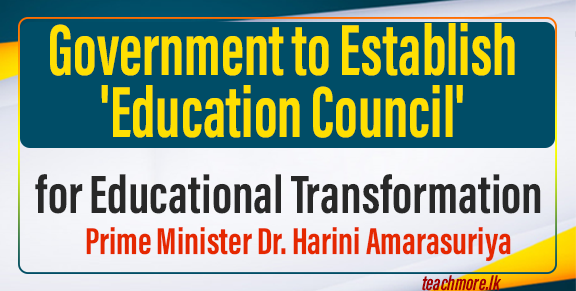
In a move aimed at transforming the country’s education sector, the government has announced plans to establish an ‘Education Council.’ The initiative is set to enhance the professionalism and quality of education, with implementation scheduled under the upcoming education reforms in 2026.
Prime Minister and Minister of Education, Higher Education, and Vocational Education, Dr. Harini Amarasuriya, emphasized the need to nurture dedicated and capable stakeholders within the education system. Speaking at a capacity-building program at the Educational Leadership Development and Management Faculty of the National Institute of Education in Meepe, she highlighted the government’s commitment to a significant educational overhaul.
“We are preparing to lead the country’s education system into a new era, similar to the transformative reforms introduced by Dr. C.W.W. Kannangara. Achieving this requires active dialogue with various stakeholders, and we seek your engagement in this process. Education is not just a professional responsibility but a civic duty, and the future of this transformation lies in your hands,” the Prime Minister stated.
Salary Revisions for Public Sector Employees
Dr. Amarasuriya also addressed the long-awaited salary increments for public sector employees, including teachers and principals. She acknowledged the financial constraints but assured that the government had made a firm decision to increase base salaries despite economic challenges.
“We have prioritized raising teachers’ and principals’ salaries among the top ten public sector salary scales. The Treasury and the Ministry of Finance have confirmed this commitment. While this may not resolve all financial concerns, it represents a step forward in addressing salary disparities,” she added.
A Systemic Transformation Beyond Reforms
Acknowledging existing inefficiencies within the education system, the Prime Minister stressed that systemic transformation is necessary.
“A true transformation requires change from within. The education system is not just about policies but about the people who operate it. If we change, the system will change. The establishment of the Education Council will be a crucial step in driving this transformation.”
Five Pillars of the 2026 Education Transformation
The upcoming educational transformation in 2026 will focus on five key areas:
- Curriculum revision and modernization
- Teacher training and professional development
- Infrastructure development
- Social dialogue and communication strategies
- Assessment system reforms
Dr. Amarasuriya highlighted that in the past year, only 50% of the allocated education budget was spent. She urged for a more effective utilization of resources to ensure the successful implementation of the transformation strategy.
The event was attended by senior officials from the Ministry of Education, including Additional Secretary (Education Services) K.K.P. Ariyasinha, alongside other education stakeholders.