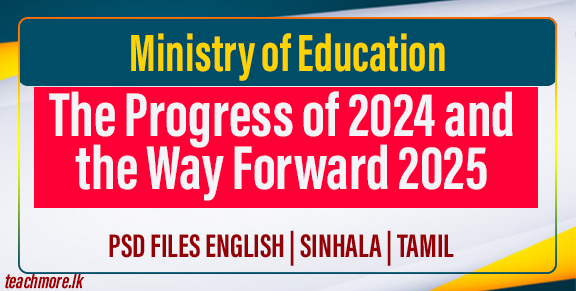
The Ministry of Education, Higher Education, and Vocational Education has released its comprehensive “Progress Report 2024 and Way Forward 2025”, showcasing a wide range of reforms, achievements, and future plans aimed at transforming Sri Lanka’s education system to meet global standards.
Major Highlights of 2024
Despite economic challenges, the Ministry successfully implemented numerous student welfare initiatives:
- School Uniforms and Textbooks were distributed to over 4.5 million students.
- The School Meals Programme benefited 1.4 million students.
- Over Rs. 937 million in scholarships were provided to low-income Grade 5 Scholarship recipients.
- New initiatives were launched to promote AI education, digital literacy, and ICT integration in 1,000 schools.
Additionally, major upgrades were made in teacher training, school infrastructure, and vocational education, aligning students’ learning with market demands.
Key Achievements in Technology & Innovation
- AI Clubs were established in 100 pilot schools.
- A national-level ICT Champions Competition was held, with winners participating in international contests.
- Over 1,000 smartboards were distributed to enhance blended learning in A/L ICT classrooms.
- The National Education Management Information System (NEMIS) and teacher transfer systems were digitalized, improving efficiency and transparency.
Education Reforms and Policy Developments
The Ministry emphasized its commitment to student-centered education, reducing exam dependency, and modernizing the curriculum. With pilot schools already running, large-scale reforms are scheduled to roll out by 2026, backed by Cabinet-approved plans for a new University of Education and upgraded National Colleges of Education.
A special focus was placed on:
- Curriculum reforms across all levels.
- Addressing mismatches between education and the job market.
- Promoting inclusive, digital, and vocational education opportunities.
Looking Ahead to 2025
The Ministry has outlined the following strategic initiatives:
- Expansion of early childhood education and inclusive primary education with improved transport and infrastructure.
- Introduction of a flexible curriculum for senior secondary students, allowing choices between academic and vocational paths.
- Implementation of the “Clean Sri Lanka” Project within schools to foster social, ethical, and environmental responsibility.
- Creation of a Vocational Education Bureau to oversee quality and industry relevance.
- Recruitment of over 30,000 new teachers and educational officers, including under the “English for All” initiative.
National Focus on English and Math Education
- Digital resources and teacher development programs were expanded to meet learning targets in English and Mathematics in over 500 schools.
- Training programs were conducted for teachers on higher-order thinking, STEAM education, and inquiry-based learning.
Enhancing Global Connectivity
The Ministry managed 279 official foreign visits and secured international collaboration and aid, including participation in World Bank missions and technical assistance for digital transformation.